
Let me tell you a story I hear far too often in Maryland. A couple buys a beautiful century-old colonial in Takoma Park. The standard home inspection comes back clean. Three months later, the basement floods with sewage. The culprit? A collapsed clay sewer pipe no one checked. Suddenly, they’re staring at a $15,000 repair bill that insurance won’t cover.
Maryland is packed with older homes full of character. From Baltimore row houses to Silver Spring bungalows, many were built when indoor plumbing was still a new idea. Yet most buyers only rely on a basic home inspection before signing the dotted line. Here’s the thing: that inspection completely skips the underground sewer line. A sewer scope inspection before buying a house costs a few hundred dollars today but can save you thousands tomorrow. Think of it as cheap insurance against a very messy disaster. Let me walk you through everything you need to know.
What Is a Sewer Scope Inspection?
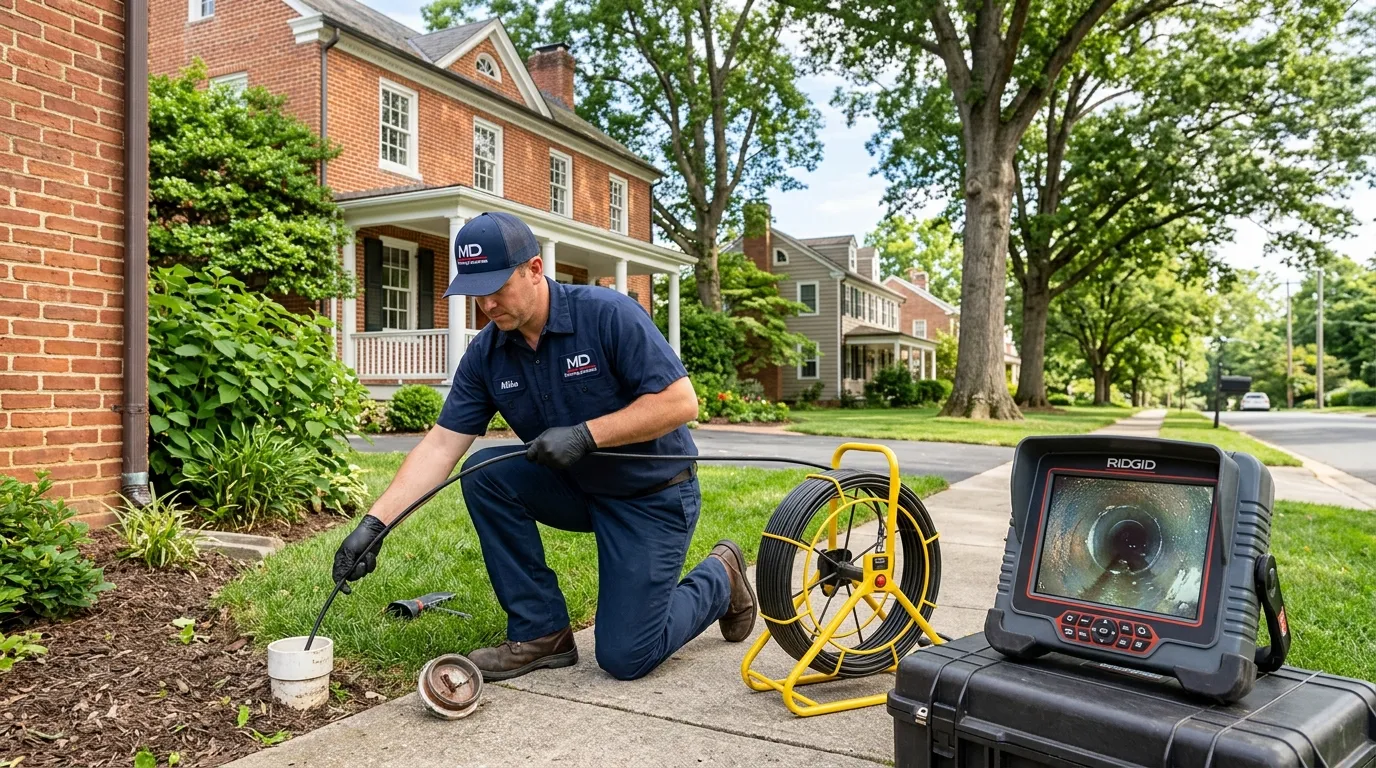
Think of a sewer scope as a colonoscopy for your house. A trained technician inserts a flexible, waterproof camera attached to a long cable down your cleanout or through a toilet flange. This camera travels through your main sewer lateral, the pipe connecting your home to the public sewer main under the street. As it snakes along, it beams back real-time high-definition video to a monitor.
The technician watches for cracks, blockages, standing water, root intrusion, and pipe material condition. After about 30 to 60 minutes, you get a detailed report with still images and video clips showing exactly what’s happening underground. No guesswork, no surprises. Just a clear picture of your sewer line’s health before you commit to the biggest purchase of your life.
Why a Standard Home Inspection Isn’t Enough
I wish more buyers understood this distinction because it creates a dangerous blind spot. A standard home inspection is a visual, non-invasive examination of accessible systems. Your inspector will climb the roof, test every outlet, run the furnace, and flush every toilet. They’re checking for visible defects you can see with the naked eye.
Your inspector checks the roof, HVAC, plumbing fixtures, electrical panel, and foundation walls. But they do not inspect the underground sewer pipe, the sewer lateral, or the pipe condition beneath your yard. Why? Because these pipes are buried several feet underground. Your inspector doesn’t have X-ray vision. They can’t see what’s happening 100 feet out toward the street. A toilet can flush perfectly during a 15-minute test but completely fail after you move in because of a hidden belly or root mass further down the line. Relying solely on a standard inspection leaves a massive financial blind spot underground.
Why Maryland Homes Are More Likely to Have Sewer Problems
Maryland isn’t just any housing market. Our state has a unique combination of age, geography, and weather that makes sewer problems incredibly common. If you’re house hunting in our older communities, pay close attention.
Older Neighborhoods Everywhere
Drive through Baltimore’s historic districts, downtown Annapolis, Silver Spring, Frederick, Hyattsville, or Takoma Park, and you’ll fall in love with tree-lined streets and homes built decades ago. But beneath those charming lawns lurk aging pipes installed before modern materials existed. Many of these homes still have original clay pipes, which are brittle and have joints tree roots easily penetrate. Others have cast iron sewer lines that rust and corrode from the inside out over 50 or 60 years. The infrastructure is simply reaching the end of its lifespan.
Those Beautiful Mature Trees
We love Maryland’s lush, green neighborhoods. Those massive oak and maple trees add beauty and shade, but their roots are constantly searching for moisture and nutrients underground. A tiny crack in your sewer pipe releases warm, nutrient-rich vapor. Roots follow that trail like a roadmap. They enter through the smallest gap, then expand inside the pipe, catching debris and eventually creating a complete blockage. I’ve seen pipes where you couldn’t even see the opening because roots had completely filled the diameter.
Freeze-Thaw Cycles and Weather
Maryland weather swings between cold winters and hot summers. The ground constantly freezes, thaws, expands, and contracts. These temperature changes put stress on buried pipes year after year. The movement can crack rigid clay pipes, shift pipe joints out of alignment, and cause ground movement that creates bellies or low spots where water stagnates. Over decades, this cycle does real damage.
Hidden Sewer Problems Buyers Often Miss
Tree Root Intrusion
This is the most common issue I see in Maryland homes. Roots enter through microscopic cracks or loose joints. As they grow thicker inside the pipe, they act like a net, catching toilet paper, grease, and waste. You’ll notice slow drains first, then gurgling toilets, and eventually recurring backups. A simple root intrusion treated early might cost a few hundred dollars. Left untreated, it can destroy the entire pipe, requiring complete replacement.
Broken or Cracked Sewer Pipes
Pipes don’t last forever. Aging takes its toll, but so does heavy traffic constantly driving over the yard, ground movement from nearby construction, or shifting soil after heavy rains. A crack lets soil in and sewage out. You might not notice until the ground sinks or you smell something foul near the foundation. By then, the pipe may already be collapsed.
Offset Pipe Joints
Older clay pipes were installed in sections with joints every few feet. Over time, ground movement pushes these sections apart so they no longer line up perfectly. When joints offset, a lip forms inside the pipe. Waste catches on that lip, accumulating until only a tiny channel remains for flow. Blockages become a frustrating, recurring nightmare.
Bellied Sewer Pipes
A belly is a low spot where the pipe sags downward, creating a dip that holds standing water and debris constantly. Gravity can’t do its job because waste has to travel uphill to exit the belly. Solids settle there and decompose, causing odors and eventual blockages. This often requires excavation to fix because the pipe has lost proper slope.
Corroded Cast Iron Pipes
Cast iron was the gold standard decades ago, but nothing lasts forever. These pipes rust from the inside out, developing scale and tuberculation that narrows the passageway. Eventually, the bottom of the pipe rusts through completely, leaving a channel of soil where your pipe used to be. This is especially important for Maryland older homes built before the 1970s.
Orangeburg Pipes
If you’re looking at a home built between 1940 and 1970, you might encounter Orangeburg pipe. This was made from compressed wood pulp and tar paper, essentially a heavy cardboard tube. It was meant as a cheap, temporary solution. Decades later, these pipes are prone to collapse, deforming into an oval shape until they flatten completely. Finding Orangeburg is almost always a guaranteed replacement situation.
Collapsed Sewer Lines
This is the worst-case scenario. When a pipe completely caves in, sewage has nowhere to go but back into your home. A collapsed sewer line requires major excavation, sometimes tearing up the street or sidewalk. Complete sewer replacement becomes the only option, easily running into five figures. This is exactly what we’re trying to catch before closing.
Signs That a Home May Have Sewer Problems
When you’re touring a potential home, keep your senses alert. Slow drains that gurgle after flushing aren’t just annoying, they’re a red flag. Multiple clogged fixtures backing up simultaneously suggest a main line problem, not an isolated clog. If you catch a sewer odor inside or outside near the foundation, trust your nose. Walk the yard looking for unusually lush green patches, wet spots, or sinkholes where soil has washed into a broken pipe. Ask the seller directly about frequent backups. These signs don’t always mean disaster, but they absolutely demand a sewer scope before you commit.
Average Sewer Repair Costs in Maryland
I want to give you real numbers so you understand what’s at stake. These are approximate Maryland ranges based on what contractors charge in our area.
A camera inspection alone runs $250 to $500. Hydro jetting to clear roots costs $300 to $700. A minor spot repair might range from $800 to $2,500. Trenchless pipe lining, where they create a new pipe inside the old one, typically falls between $3,000 and $10,000 depending on length. A complete sewer line replacement using traditional excavation can easily reach $6,000 to $20,000 or more if the pipe runs deep or goes under a driveway. Actual costs vary by county, pipe depth, length of the run, and material chosen. But the pattern is clear: inspection is cheap, repair is expensive.
Best Time to Schedule a Sewer Scope Inspection
Timing is everything in real estate. The ideal window is right after your offer is accepted, during the inspection contingency period, and before final negotiations. This gives you maximum leverage. If the scope reveals a $10,000 problem, you can request the seller repair it, negotiate a price reduction or credit at closing, or walk away with your earnest money intact if the deal allows. Don’t wait until after closing. Once those keys are in your hand, the problem is yours alone.
Benefits for Maryland Homebuyers
- Avoid surprise repairs that insurance won’t cover
- Stronger negotiating position with documented evidence
- Peace of mind knowing what’s underground
- Protect your investment from hidden defects
- Save thousands of dollars before they become your problem
Benefits for Maryland Home Sellers
Sellers, this applies to you too. Proactively getting a sewer scope inspection before listing leads to a faster closing because there are no last-minute surprises. It builds buyer confidence when you can hand over a clean video of the sewer line. Fewer surprises mean reduced negotiation delays and a stronger listing position. In a competitive market, transparency sets you apart.
Frequently Asked Questions
Is a sewer scope inspection really worth it?
Absolutely. Spending $300 to $500 now can prevent a $15,000 repair six months later. The math speaks for itself. For homes older than 20 years, it’s practically essential.
Does Maryland require sewer inspections before selling?
No, Maryland does not mandate sewer inspections during real estate transactions. The responsibility falls entirely on you, the buyer, to perform due diligence.
Who pays for the sewer scope inspection?
Typically, the home buyer pays as part of their due diligence inspections. However, everything in real estate is negotiable, and some buyers successfully request reimbursement.
How long does a sewer scope inspection take?
Most inspections take between 30 and 60 minutes from setup to breakdown. You’ll usually receive the video and report the same day.
Can a home pass a standard inspection but still have sewer problems?
Yes, every single day. Standard home inspectors don’t run cameras down sewer lines. A toilet flushes fine during a quick test but may back up once you start living there because of a hidden belly or root mass further down the pipe.
Final Thoughts
Sewer issues hide silently underground until they don’t. A standard home inspection simply isn’t enough to catch them. Maryland’s older housing stock, mature trees, and freeze-thaw cycles increase the risk significantly. Spending a few hundred dollars now on a sewer camera inspection before buying prevents the kind of financial shock that keeps new homeowners awake at night. Don’t skip this step. Your wallet and your basement will thank you.
Buying a home in Maryland? Schedule a professional sewer scope inspection before buying a house to identify hidden sewer issues, avoid costly repairs, and negotiate with confidence. Contact our Maryland sewer inspection team today to book your inspection.


