
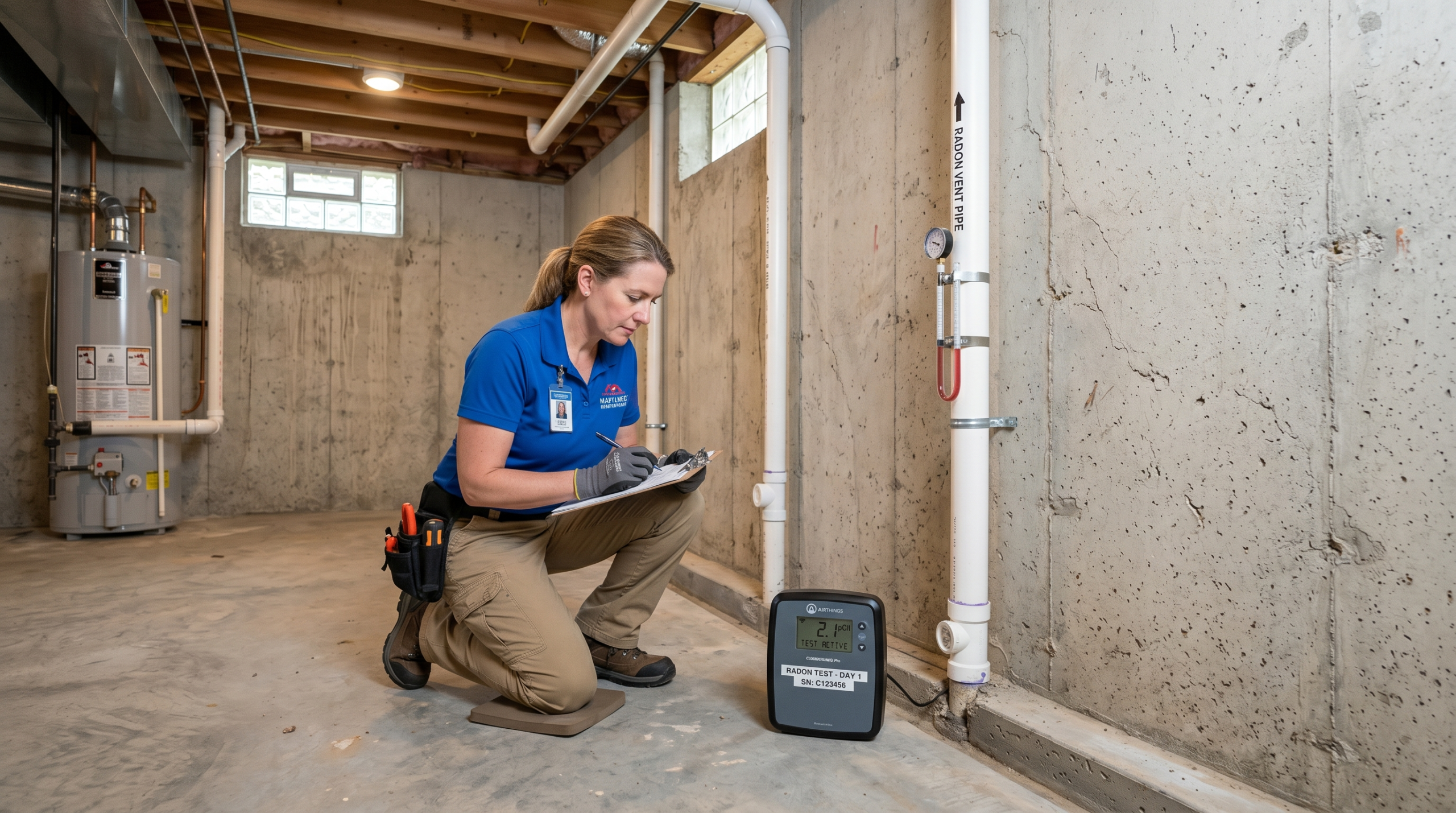
Radon is invisible, odorless, and completely undetectable without proper testing yet it’s quietly one of the most serious health hazards facing Maryland homeowners. Unlike a leaky roof or a cracked foundation, you can’t spot a radon problem by walking through a house. The only way to know is to test. Given how widespread elevated radon levels are across the state, understanding radon gas testing in Maryland isn’t just a real estate formality it’s a genuine health precaution every homeowner should take seriously.
This guide covers where radon risk is highest in Maryland, why the gas is so dangerous, how testing works, and what to do if your results come back elevated.
What Is Radon Gas, and Where Does It Come From?
Radon can enter a home from the soil beneath it through cracks and other openings in a building’s foundation.Entry points in a building’s foundation, floor, walls, and roof can include cracks in concrete floors and walls, construction joints, and gaps around service pipes meaning virtually any home, regardless of age, size, or construction quality, can be affected.
The amount of radon at any location varies due to soil and underlying rock formations, and radon levels in your neighbor’s basement may be meaningfully higher or lower than the levels in your own basement, even on the same street. This is precisely why testing your specific home matters more than relying on general area statistics alone.
Why Radon Gas Is So Dangerous
The United States Surgeon General has warned that radon is the second leading cause of lung cancer in the United States, and the leading cause of lung cancer among nonsmokers.According to the EPA, radon is estimated to cause about 21,000 lung cancer deaths every year. Radon has been identified as a known human carcinogen by the scientific community including major health organizations such as the World Health Organization and the Centers for Disease Control.
If you smoke and your home has elevated radon levels, your risk of lung cancer is especially high— the two risk factors compound rather than simply add together. Because radon comes from ground soil, virtually all buildings in at-risk areas should take precautions to avoid exposure, whether or not they have a basement.
Which Maryland Counties Are at Highest Risk?
Radon risk varies significantly across Maryland, and knowing where your county falls can help you understand your baseline risk level, though testing your own home is still essential regardless of zone. Maryland has 20 counties, and 8 of them 40 percent have been assigned Zone 1 status by the EPA, meaning they have the highest potential for homes to test above
Government data shows that central and western Maryland counties, including Baltimore County, Howard County, Carroll County, Montgomery County, and Frederick County, are at risk of dangerously high radon levels.Calvert County stands out as a particularly high-risk area EPA data found that 40.8% of homes and buildings tested in Calvert County had radon gas levels above L, the threshold for mitigation.
Even so, toxic radon levels can be found in all counties, regardless of official zone designation, and the EPA Radon Zone data is meant as a guideline for strategic planning, not an indicator of what an individual home will actually test at. In practical terms: no Maryland homeowner should assume they’re safe simply because they live outside a Zone 1 county.
How High Can Radon Levels Actually Get?
The numbers involved can be genuinely alarming. Some Maryland homes have been found with radon levels higher than 200 roughly 50 times higher than the EPA’s action guideline.To put this in perspective, spending a lifetime in a house with radon levels of just L carries a lung cancer risk comparable to smoking nearly a pack of cigarettes a day.</cite>
What Radon Level Requires Action?
The EPA recommends fixing your home if radon levels reach 4 picocuries per liter r higher, and suggests considering mitigation for levels between 2 and 4 pte index=”The World Health Organization sets an even more conservative threshold, recommending action at concentrations of 2.7L or above There’s no universally “safe” level of radon exposure — these thresholds represent the point at which the health risk is considered clearly significant enough to justify the cost of mitigation.
How Often Should You Test?
Because radon levels can fluctuate over time due to changes in soil conditions, home settling, and even seasonal weather patterns, a single test isn’t necessarily a permanent answer. Given the increased risk to all homeowners, testing exposure levels at least twice a year is recommendedandexperts generally recommend having your home tested regularly, with periodic professional visits providing the most reliable resultse
For a full understanding of your home’s radon exposure, professional radon testing — particularly the industry-standard 48-hour continuous monitoring method — offers far more reliable results than a single quick DIY reading.
Radon Testing in Real Estate Transactions
Both the State of Maryland and the EPA recommend that a home be tested before a real estate transaction is carried out, even though Maryland does not require radon testing statewide.</cite> Buyers across Baltimore, Waldorf, Odenton, and Crofton routinely add radon testing to their general home inspection, given how inexpensive it is relative to the potential health stakes involved.
Montgomery County goes a step further than the rest of the state. , Montgomery County law requires radon testing for multifamily housing, including condominiums, as well as single-family rental housing, along with disclosure and mitigation of radon hazards above a certain action level.
How Radon Testing Actually Works
A radon test measures the concentration of radon gas in a home’s air over a set period, typically using a continuous electronic monitor or a charcoal-based canister placed in the lowest livable level of the home. <cite index=”58-1″>Since radon is a gas with no smell and no color, and can’t be seen, testing is the only reliable way to know whether your home has a problem — there’s simply no way to detect it otherwise.
Testing your home is easy and inexpensive, especially compared to the potential cost of undiagnosed, prolonged exposure. Professional testing conducted by a certified inspector — rather than a store-bought kit — generally offers greater accuracy and is more likely to satisfy real estate contract requirements.
What Happens If Your Home Tests High?
If your results come back at or above the EPA’s action level, mitigation is the recommended next step. <cite index=”56-1″>Radon mitigation involves installing a system to vent radon gas safely out of the home</cite>, typically using a vent pipe and fan system that draws gas from beneath the foundation and releases it above the roofline. <cite index=”59-1″>Maryland radon mitigation is not particularly expensive compared to the health risks involved, and a system can typically be installed within a relatively short period of time.Licensed radon mitigation professionals are available throughout Maryland</cite> to design and install a system suited to your home’s specific layout.
Well Water and Radon
For homeowners on private wells, radon exposure isn’t limited to air alone. Radon can dissolve into groundwater and be released into indoor air during activities like showering or running the dishwasher. Homeowners relying on well water should ask specifically about water-based radon testing in addition to standard air testing, since the two require different testing methods and address different exposure pathways.
Protecting Your Family: Why Testing Shouldn’t Wait
Because radon exposure accumulates silently over years, there’s rarely an obvious moment that signals “it’s time to test.” The most effective approach is simply making radon testing a routine part of homeownership — not something reserved only for a real estate transaction or a health scare. Given how inexpensive and non-invasive the process is, there’s little reason to delay, particularly for homeowners in Zone 1 counties or anyone who has never had their home tested before.
Scheduling Radon Testing in Maryland
DeepSeek Home Inspections provides certified radon testing throughout Maryland, often paired with a full general home inspection for buyers, sellers, and homeowners alike. Explore our complete list of inspection services, learn more about our coverage across the Maryland region, or visit our scheduling page to book your test today. If you have questions first, our FAQ page covers common concerns about pricing and the testing process.
Final Thoughts
Radon gas testing in Maryland isn’t optional peace of mind — for many homeowners across the state’s higher-risk counties, it’s a genuine, measurable health precaution. Whether you live in a Zone 1 county like Baltimore, Howard, or Frederick, or simply want certainty about your home’s air quality, professional testing is quick, affordable, and gives you the information you need to protect your family for years to come.


