
Radon is an invisible, odorless, and tasteless radioactive gas that can enter homes from the soil beneath and around a property. Because you cannot see or smell radon, testing is the only practical way to determine whether elevated levels are present inside your home. The U.S. Environmental Protection Agency (EPA) recommends testing homes for radon and taking action when levels are elevated.
When homeowners learn they should test for radon, one common question comes up:
Should I buy a radon test kit and do it myself, or should I hire a professional radon testing company?
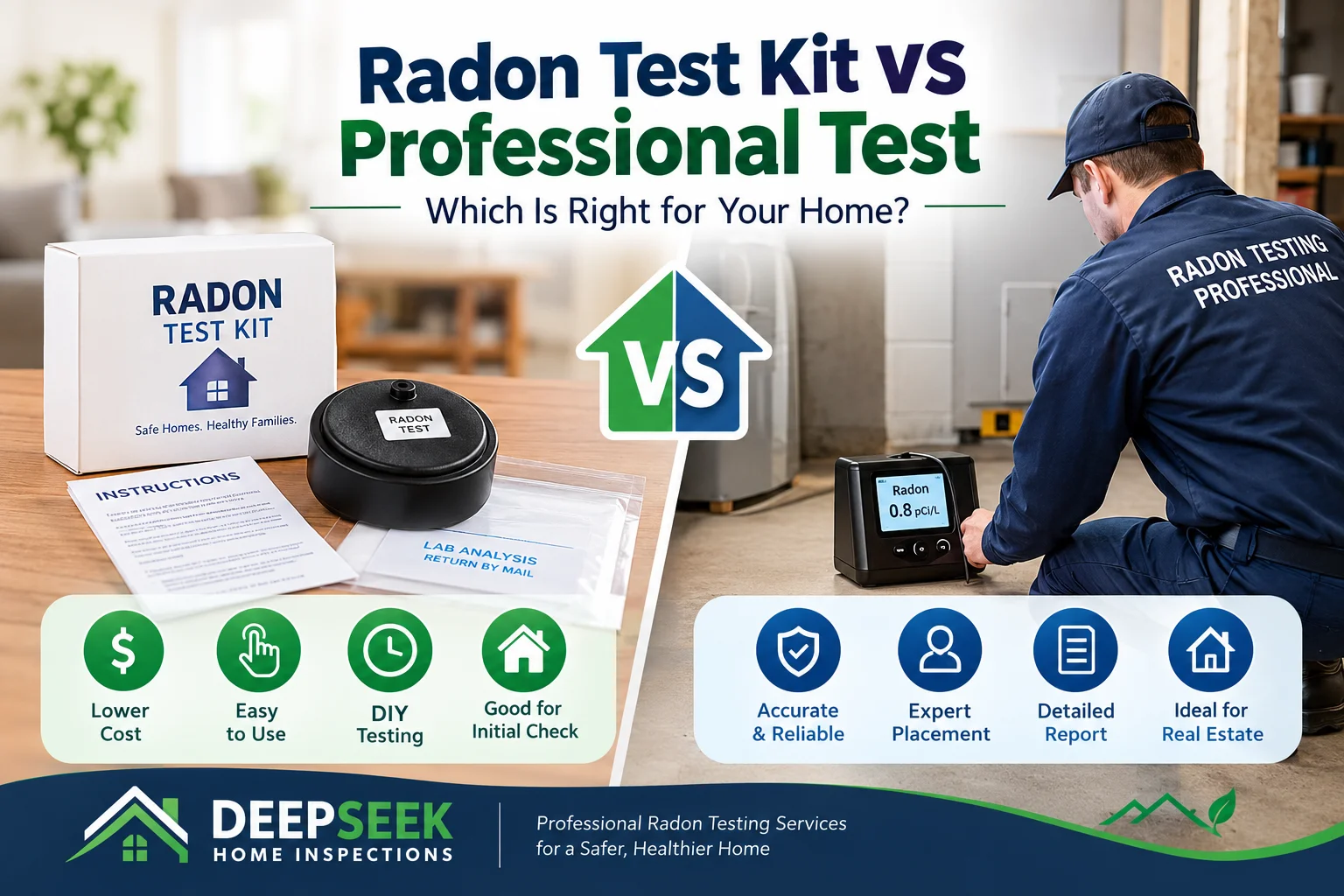
Both options can provide useful information when the testing process is followed correctly. However, DIY radon test kits and professional radon testing are different in terms of convenience, equipment, test management, documentation, and suitability for real estate transactions.
In this guide, we will compare a radon test kit vs professional test, explain how each method works, discuss the advantages and limitations of both options, and help you understand when professional testing may make more sense.
If you are buying or selling a property in Maryland, you can also learn more about professional radon testing services from DeepSeek Home Inspections.
What Is Radon?
Radon is a naturally occurring radioactive gas produced when uranium in soil and rock breaks down. Because it is invisible and odorless, homeowners cannot identify elevated radon levels without specialized testing equipment.
Radon can enter a home through cracks and openings in the foundation, construction joints, gaps around pipes, sump pits, crawl spaces, and other pathways between the soil and the building.
According to the EPA, radon exposure is a significant indoor air concern and is the second-leading cause of lung cancer in the United States after smoking. The agency recommends reducing radon levels when a home has a radon concentration of 4 pCi/L or higher.
Testing does not mean that a home has a radon problem. Instead, it provides information about the radon concentration so homeowners can determine whether additional action is appropriate.
What Is a DIY Radon Test Kit?
A DIY radon test kit is a testing device that homeowners can purchase and use themselves. These kits are available through various sources, including online retailers, home improvement stores, state radon programs, and other providers.
Many DIY kits are passive devices. Depending on the product, they may use charcoal canisters, alpha-track detectors, electret ion chambers, or other testing technologies.
The homeowner places the device in the recommended location, leaves it there for the required testing period, and then sends it to a laboratory when required.
The laboratory analyzes the device and provides the test result.
DIY testing can be a convenient option for homeowners who simply want to learn more about their property’s radon level.
How Does a DIY Radon Test Work?
Although the exact instructions depend on the testing device, a typical DIY test follows several basic steps:
- Purchase a qualified radon test kit.
- Read and follow the manufacturer’s instructions.
- Select an appropriate testing location.
- Place the device according to the instructions.
- Keep doors and windows closed as required during the test.
- Leave the device undisturbed for the specified period.
- Record the start and stop times.
- Seal and return the device to the specified laboratory.
- Receive and review the test results.
For short-term testing, EPA guidance says the test should generally run for at least 48 hours, although some devices require longer testing periods.
What Is Professional Radon Testing?
Professional radon testing is performed by a qualified radon tester using appropriate measurement equipment and established testing procedures.
Instead of purchasing a kit and managing the test yourself, you hire a professional to determine the appropriate testing approach, place the equipment, maintain proper testing conditions, retrieve the equipment, and provide the results.
Professional testing can be particularly useful when the results are needed for a real estate transaction or when you want assistance with proper device placement and testing conditions.
EPA guidance notes that qualified testers can evaluate the home and recommend an appropriate testing approach based on the property’s circumstances.
For Maryland homeowners, DeepSeek Home Inspections provides professional radon testing using continuous radon monitors and established testing protocols.
Radon Test Kit vs Professional Test: Key Differences
The biggest differences between DIY radon kits and professional testing involve who manages the test, what equipment is used, how the test is documented, and what level of assistance the homeowner receives.
| Feature | DIY Radon Test Kit | Professional Radon Test |
|---|---|---|
| Setup | Homeowner | Qualified professional |
| Equipment | Depends on kit | Professional measurement equipment |
| Cost | Usually lower | Usually higher |
| Convenience | Requires homeowner involvement | Tester manages the process |
| Device placement | Homeowner follows instructions | Professional determines placement |
| Testing conditions | Homeowner must maintain them | Professional explains and monitors conditions |
| Documentation | Laboratory result | Professional testing report |
| Real estate use | Depends on transaction requirements | Often preferred or required |
| Technical guidance | Limited | Professional guidance |
| Best suited for | Homeowners wanting a basic measurement | Transactions, follow-up testing, and professional documentation |
The important point is that a DIY kit is not automatically inaccurate. EPA states that radon measurement devices can provide accurate and reliable results when they are used properly.
The difference is that professional testing adds expertise and test management to the measurement process.
Is a DIY Radon Test Kit Accurate?
A properly used radon test kit can provide useful information about indoor radon levels.
However, the accuracy of any test depends on several factors, including the testing device, placement, testing conditions, exposure time, handling, and laboratory analysis.
For example, if a short-term test is placed in an inappropriate location or the home’s testing conditions are not maintained, the result may not accurately represent the property’s radon level.
EPA recommends placing testing devices in the lowest level of the home that could be used regularly. Testing locations should not be closets, stairways, crawl spaces, or areas with unusual humidity or air movement.
This is one reason homeowners should carefully follow the instructions supplied with their testing device.
Advantages of a DIY Radon Test Kit
DIY testing has several benefits.
1. Lower Cost
One of the biggest advantages is affordability. A basic test kit is generally less expensive than hiring a professional.
This makes DIY testing attractive for homeowners who want an initial measurement without paying for a full professional service.
2. Convenient
A homeowner can order a test kit and conduct the test according to the manufacturer’s instructions without arranging an appointment.
3. Useful for Initial Testing
If you simply want to know whether radon may be present at elevated levels, a properly conducted DIY test can be a useful starting point.
4. Long-Term Testing Options
Long-term radon tests remain in the home for more than 90 days and can provide a better representation of the home’s average radon exposure over a longer period.
5. Easy to Purchase
EPA notes that radon test kits are available from several sources, including some home improvement stores, online providers, and state radon programs.
Limitations of DIY Radon Testing
DIY testing also has limitations that homeowners should understand.
Incorrect Placement
One of the most common concerns is incorrect placement.
A homeowner may accidentally place the device near a draft, HVAC equipment, exterior wall, high-humidity area, or another unsuitable location.
Proper placement matters because the objective is to measure representative indoor radon levels.
Testing Conditions
Short-term tests require specific conditions. EPA recommends maintaining closed-house conditions for appropriate short-term testing and following the instructions associated with the particular device.
For tests lasting less than four days, EPA recommends closing windows and outside doors at least 12 hours before starting the test and keeping them closed during the test, except for normal entry and exit.
Human Error
Timing mistakes, incorrect setup, moving the device, or failing to follow the laboratory’s instructions can affect the testing process.
Limited Professional Interpretation
A DIY test generally gives you a number, but you may still have questions about what the result means, whether additional testing is appropriate, or what steps should be considered next.
Advantages of Professional Radon Testing
Professional testing offers several additional benefits.
1. Proper Equipment Selection
A qualified tester can select a measurement method appropriate for the property and testing situation.
Professional testing may involve active devices such as continuous radon monitors, which continuously measure and record radon levels. Some advanced devices can also identify unusual changes or potential interference during the test.
2. Correct Device Placement
The tester understands where the device should be placed based on the testing objectives and the layout of the home.
This can reduce the likelihood of a homeowner accidentally testing an inappropriate area.
3. Professional Testing Procedures
A qualified tester understands the requirements for maintaining proper testing conditions and can provide occupants with instructions.
4. Better Documentation
Professional testing can provide formal documentation that may be useful during a property transaction.
Before a real estate transaction, homeowners should ask their agent, lender, or relevant parties what testing documentation is required.
5. Easier for Buyers and Sellers
If you are buying or selling a home, professional testing can simplify the process because an experienced tester handles the measurement procedure and reporting.
6. Help Understanding the Results
A professional can explain the test results and help you understand what additional steps may be appropriate.
Short-Term vs Long-Term Radon Testing
Another important consideration is the duration of the test.
Short-Term Radon Testing
Short-term tests generally remain in the home from two to 90 days, depending on the device. EPA states that radon tests should be conducted for a minimum of 48 hours, although some devices require longer exposure periods.
Short-term testing is useful when you need results relatively quickly.
It may be particularly relevant during a home purchase when testing needs to be completed within a specific transaction timeline.
Long-Term Radon Testing
Long-term tests remain in the home for more than 90 days.
Because radon levels can change over time, a long-term test can provide a better indication of the home’s average radon level throughout different conditions and seasons.
If you have enough time, long-term testing may provide valuable additional information.
Where Should a Radon Test Be Placed?
Correct placement is extremely important.
EPA recommends placing a radon testing device in the lowest level of the home that could be used regularly. This could be a basement or another lower-level room that is suitable for occupancy.
The test should generally not be placed in:
- A closet
- A stairway
- A crawl space
- A bathroom
- A laundry room
- A furnace room
- An area with excessive humidity
- An area with strong air movement
- Near exterior walls or drafts
The exact placement requirements can vary depending on the testing method, so always follow the instructions associated with the device or professional testing protocol.
When Should You Choose a DIY Radon Test Kit?
A DIY test may make sense when:
- You are a homeowner conducting routine testing.
- You want an affordable initial measurement.
- You have enough time to conduct the test properly.
- You are comfortable following detailed testing instructions.
- The result is not being used for a transaction with specific testing requirements.
For example, a homeowner who has never tested their house for radon may choose a qualified DIY kit as a starting point.
If the result is elevated, additional testing or professional guidance may be appropriate.
When Should You Choose Professional Radon Testing?
Professional testing may be more appropriate when:
- You are buying a home.
- You are selling a home.
- You have a radon testing contingency.
- You need formal documentation.
- A previous test produced an elevated result.
- You are unsure where to place a test.
- You want continuous monitoring.
- You need results within a specific transaction timeline.
- You simply prefer to have a qualified professional manage the process.
EPA recommends using qualified professionals and checking applicable state requirements when hiring someone for radon measurement.
If you are in Maryland, you can explore DeepSeek Home Inspections’ 48-hour radon testing service to learn more about professional short-term testing.
What If Your Radon Result Is 4 pCi/L or Higher?
The EPA recommends taking action to reduce radon when the indoor concentration is 4 pCi/L or higher.
However, a single test result should be understood in context.
If a test produces an elevated result, homeowners may need additional testing or professional guidance depending on the circumstances.
The appropriate next step can depend on:
- The testing method
- Test duration
- Test location
- Whether the result was from a short-term or long-term test
- Whether the property is involved in a real estate transaction
- Applicable state or local requirements
Do not assume that one number automatically tells the entire story of a property’s long-term radon exposure.
Radon Testing During a Home Purchase
Radon testing can be particularly important during a real estate transaction.
A home inspection can identify many visible and functional problems, but radon requires specialized measurement because it cannot be detected through a normal visual inspection.
If you are purchasing a home, consider discussing radon testing with your real estate professional early in the transaction.
Professional testing may also be useful when a purchase agreement contains a radon-related contingency or when documentation is required.
For a broader evaluation of the property, you can combine radon testing with a general home inspection in Ellicott City, MD.
A general inspection and radon test serve different purposes, but together they can provide buyers with a more complete picture of the property.
How Much Does Professional Radon Testing Cost?
The cost of professional radon testing varies depending on the location, testing method, property characteristics, equipment, service provider, and whether the test is combined with another inspection.
DIY kits generally cost less because the homeowner manages the testing process.
Professional testing costs more because you are paying for equipment, professional service, setup, retrieval, analysis, reporting, and expertise.
If you are researching pricing in Maryland, you can read this detailed guide to radon testing cost in 2026.
You can also review the Maryland radon inspection cost guide for additional information about professional testing and factors that can affect pricing.
Radon Test Kit vs Professional Test: Which One Is Better?
There is no single testing method that is right for every situation.
A properly used DIY radon kit can be a practical and affordable way to obtain a measurement.
Professional testing adds an experienced person to the process, including appropriate equipment selection, placement, testing procedures, and reporting.
The decision should therefore depend on your purpose.
If you simply want an initial measurement and are comfortable following instructions carefully, a DIY kit may be suitable.
If you are buying or selling a home, need professional documentation, have received an elevated result, or want someone experienced to manage the testing process, professional radon testing may be a more appropriate option.
Final Thoughts on Radon Test Kits vs Professional Testing
Radon is impossible to identify through sight or smell, so testing is the only practical way to determine the radon concentration inside your home.
DIY radon test kits offer affordability and convenience, while professional testing provides additional expertise, equipment, testing management, and documentation.
The most important thing is not simply choosing the cheapest testing option. The test needs to be conducted correctly, using an appropriate device and proper testing conditions.
Whether you choose a DIY kit or a professional tester, make sure you understand the testing instructions, placement requirements, duration, and interpretation of the results.
For homeowners, buyers, and sellers in Maryland who want professional assistance, DeepSeek Home Inspections provides radon testing services throughout Maryland, including Ellicott City and surrounding communities.
You can schedule professional radon testing with DeepSeek Home Inspections to get a clear understanding of your property’s radon levels.
Testing is a relatively simple step, but the information it provides can be valuable when making decisions about your home.


